Crop Circles Explained: History, Famous Formations, and the Search for Answers
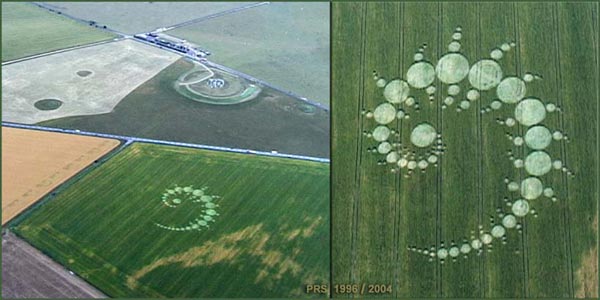
A spiral stretches across a wheat field. Hundreds of smaller circles turn it into something resembling a galaxy. Elsewhere, flattened crops form a face, a ribbon, or a number that can be read from the air.
Crop circles bring several subjects into the same landscape: geometry, agriculture, anonymous art, folklore, and the possibility of communication with an intelligence beyond humanity. Their photographs are immediately recognizable. Their history is considerably less familiar.
Many crop circles have documented human makers. Others remain unattributed, and researchers have investigated claims of unusual plant changes, lights, and rapid formation. An unidentified maker, however, is not evidence by itself of a non-human origin. The most useful account follows the designs, the people, and the evidence together.

What is a crop circle?
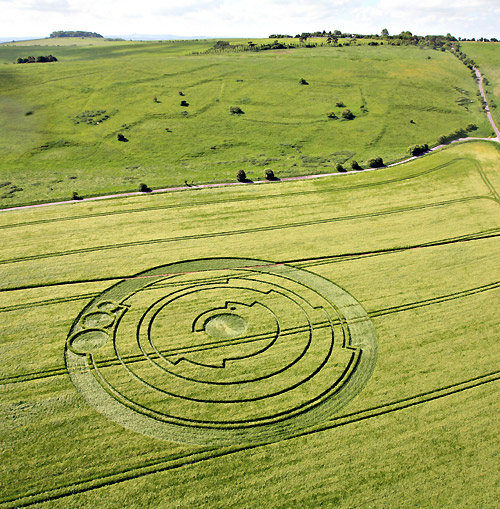
A crop circle is a pattern formed by flattening areas of a growing crop while leaving other areas standing. Wheat, barley, and oilseed rape are familiar settings. The name now covers much more than circles: rings, branching shapes, interlocking polygons, portraits, and elaborate pictograms all appear in the photographic record.
At ground level, the experience is often one of texture: stems lie in swirls, strips, or layers. From above, the contrast between upright and flattened plants reveals the larger design. Aerial photography connects those two scales, preserving formations that can disappear at harvest.
Three questions run through the subject. What is physically present? Photographs and field measurements describe that. What might the design mean? Geometry, symbolism, and proposed decoding address that. How was it made? That requires evidence about the event itself. A compelling answer to one question does not automatically answer the others.
Crop circles, cropmarks, and flattened crops
Not every shape in a field belongs to the same phenomenon. Archaeological cropmarks emerge when buried walls, ditches, and other features change the growth of plants above them. Historic England's illustrated explanation shows how differences in soil depth and moisture can reveal vanished buildings from the air.
Storms can also flatten crops, a condition known as lodging. A patch of weather-damaged wheat, an archaeological outline, and a large geometric artwork can all look striking from above, but they require different explanations. The field is the shared surface, not necessarily the shared cause.
How far back does the story go?
1678: the Mowing-Devil
One of the most frequently reproduced historical images is the Mowing-Devil pamphlet of 1678. Its story concerns a farmer who refuses a laborer's price for cutting oats and declares that he would rather have the Devil do the job. The crop is then described as mysteriously mown.
The woodcut is a genuine historical illustration of a supernatural harvest story. It is not straightforward documentation of a modern crop circle: the text describes mowing, rather than an investigated pattern of flattened standing plants. Its importance lies in the older association between strange field events and supernatural agency.
1880: circular patches in a storm-damaged field
A different kind of record appears in J. Rand Capron's 1880 letter, “Storm Effects,” in Nature. Capron described wheat knocked down in patches that looked circular from a distance after violent local storms in Surrey.
This establishes that circular areas of flattened crops were discussed long before the modern publicity surrounding crop circles. It does not establish that those patches and later complex pictograms had the same origin.
The 1960s through the 1980s: saucer nests and a growing mystery
Australian reports of “saucer nests,” including the widely discussed 1966 Tully case, connected circular disturbances in vegetation with alleged UFO encounters. These reports belong to the background of the modern crop-circle story; a disturbed patch of reeds and a geometric wheat-field formation are not identical kinds of evidence.
During the later twentieth century, southern England became the center of a much larger crop-circle conversation. Investigators Colin Andrews and Pat Delgado documented formations and helped introduce them to a wide audience through Circular Evidence, first published in 1989. The book remains an important entry in the subject's publishing history.
By the early 1990s, simple circles and rings had been joined by increasingly elaborate pictograms. The question was no longer only why a circular patch had appeared. It was how such complex designs were being laid out across entire fields.

Why southern England?
Wiltshire and neighboring counties combine large cultivated fields with an unusually visible prehistoric landscape. Stonehenge, Avebury, burial mounds, and chalk hills already give the region a strong association with ancient monuments and questions about their meaning. Rob Irving and Peter Brookesmith describe this setting in their illustrated account of crop-circle culture.
The proximity is real; explanations for it differ. Some interpreters connect formations to sacred sites or “ley lines,” imagined alignments sometimes understood as channels of earth energy. Circle-makers also describe drawing inspiration from ancient sites. The landscape can influence the people making a design, the people interpreting it, and the photographers documenting it.
The phenomenon is international. Contemporary reports from the 2002 season, for example, include German formations, while documented commissioned work extends to California and Italy. These records show geographic reach without supplying a complete worldwide census.

🔎 Famous formations: a visual field guide
The names below provide a route back to the images. Dates identify reported appearances or the dates used in the cited photographic archives; they are not automatically independently witnessed creation times. Nicknames usually describe a resemblance or interpretation, rather than an authenticated message from a known author.
The Stonehenge “Julia Set” — Wiltshire, July 7, 1996
This sweeping spiral near Stonehenge is one of the defining crop-circle images. Temporary Temples records 151 circles along a formation approximately 915 feet long. Its nickname invokes a family of mathematical fractals. See the dated aerial and landscape photographs, or open the photograph reproduced by Plus.
The “Triple Julia” — Windmill Hill, July 29, 1996
Three curling arms give this formation its familiar name. The archive itself notes that the arms are not true Julia fractals, a useful reminder that a memorable nickname is not a mathematical classification. Find the Windmill Hill aerial views and ground photographs in the 1996 gallery.
The “Galaxy” — Milk Hill, August 12, 2001
A six-armed spiral composed of 409 circles made Milk Hill a landmark case. The Temporary Temples archive gives an approximate diameter of 1,000 feet. Its photographs show the full spiral, its hillside setting, and the flattened crop at closer range. The approximate measurement is more useful than the conflicting “largest ever” claims attached to reposts.
The face and “Arecibo reply” — Chilbolton, August 2001
Two nearby formations attracted attention beside the Chilbolton radio telescope in Hampshire: a face built from patches of standing wheat and a rectangular design resembling the visual arrangement of the 1974 Arecibo message. View the photographs cataloged under Chilbolton, and see their placement in the field. Their relationship to the original broadcast is explored below.
The alien face and disc — Crabwood, near Sparsholt, August 15, 2002
A face resembling the familiar “Grey” alien appears beside a patterned disc. This is the formation associated with the warning about “false gifts,” not the Chilbolton face from the previous year. Contemporary coverage records the face, disc, and early suggestions of binary coding. Read that 2002 account or open its photograph.
The circular “DNA” design — Crooked Soley, August 28, 2002
This Berkshire formation resembles a twisted strand wrapped around a ring. The Crooked Soley photographs and this overhead view show the illusion of depth created by its patterned grid. “DNA” describes the visual interpretation; it does not mean that the design demonstrates genetic modification.
The “Pi” formation — near Barbury Castle, June 1, 2008
This stepped spiral is widely read as 3.141592654, an approximation of pi. The design turns a familiar mathematical constant into a visual puzzle. Plus explains the reading with diagrams; its photograph and additional archival views make the steps easier to follow.
The “Jellyfish” and other living forms — 2009
The 2009 photographic gallery includes a jellyfish-like formation near Wayland's Smithy, a dragonfly at Yatesbury, and an owl at Woodborough Hill. Together they show how far the visual vocabulary had expanded beyond concentric circles. The field could now hold something closer to a drawing.
What the geometry actually tells a reader
A complicated-looking design can be built from a small set of repeated rules. Rotational symmetry means a shape matches itself after a turn. Repeated circles create petals and lattices. Changing the size of successive elements produces a sense of movement or depth. A fractal uses repeated mathematical operations to generate structure across scales; a spiral alone is not necessarily a fractal.
The Barbury Castle design provides a particularly accessible example of encoding. In the published interpretation, the circle is divided into ten equal angular sections. Counting the sections traversed between outward steps gives successive digits, with a small circle marking the decimal point. The reported value rounds pi to nine decimal places.
That reading can be checked against the drawing. It establishes a meaningful relationship between the pattern and a number. It does not establish who placed the pattern in the field. Mathematics supplies a language that people can deliberately use as well as a subject that researchers can investigate.
Where sacred geometry enters the conversation
“Sacred geometry” describes traditions and interpretations that attach spiritual significance to number, proportion, and shape. Writers such as Michael Glickman explored crop formations through geometry, while John Michell and Alan Brown developed a numerical and symbolic reading of Crooked Soley. The book descriptions and publication details help distinguish their approaches.
A geometric observation and a spiritual interpretation can concern the same image without being the same kind of claim. Counting a design's repeated elements is a measurement. Associating that count with creation, consciousness, or cosmic order belongs to an interpretive framework.
The related idea that patterns in the larger cosmos correspond to patterns in earthly life has a much older history. “As Above, So Below: What It Means and Where It Comes From” explains that tradition. The connection is thematic; resemblance alone does not demonstrate a historical lineage between an ancient text and a modern formation.
Was Chilbolton an answer to a message from Earth?
There really was a message from Earth. On November 16, 1974, Frank Drake and colleagues at the Arecibo Observatory transmitted a brief binary-coded radio message into space. Researchers revisiting that project describe its history in The Last Arecibo Message.
Binary represents information using two values, conventionally written as 0 and 1. Arranged into a grid of 73 rows and 23 columns, the original 1,679 bits produce a picture containing information about humanity, chemistry, the Solar System, and the telescope. The University of Oregon provides the actual bit arrangement.
The distance matters. According to Cornell University's account of the transmission, the signal was aimed toward the M13 star cluster, approximately 25,000 light-years away. At light speed, an outbound message and an immediate reply would require roughly 50,000 years. The 2001 formation appeared only 27 years after the broadcast, so it cannot represent that ordinary round trip to M13.
The Chilbolton formation echoes that visual format, with changes to the depicted figure and other sections. Its proximity to a radio telescope strengthened the apparent connection. Contemporary coverage records the attention from Art Bell's radio audience and the debate around calling it a reply.
But the original event was a radio transmission; the later event was a pattern in a terrestrial field. The field design was not itself an extraterrestrial radio signal received by the observatory. “Arecibo reply” names the proposed relationship, not an authenticated exchange with another civilization.
And the warning beside the Crabwood face?
The 2002 face-and-disc formation is commonly interpreted as containing a binary message rendered into English. Temporary Temples reproduces a reading beginning “Beware the bearers of false gifts and their broken promises.” The remainder expresses a warning alongside hope and opposition to deception.
This is a proposed reading of information in the design. Even a correctly decoded message would not authenticate its sender. An English sentence and an alien portrait can be intentionally placed together by an unknown human author; establishing a different origin requires separate evidence.
The people who make crop circles
In 1991, Doug Bower and Dave Chorley publicly demonstrated their crop-flattening methods and claimed responsibility for many earlier formations. Their disclosure became a turning point in the debate. The Smithsonian feature includes photographs of the pair and explores the artistic culture that developed around circle-making.
The tools can be simple: measuring tapes, ropes, rollers, and boards used to press plants down. The difficult part is organizing a design at field scale. Circlemakers' own partly satirical practical guide identifies the equipment and the use of existing tractor tracks, or tramlines, for access.
The work is not limited to small circles. For Korn's 2010 performance project, John Lundberg, Wil Russell, Rob Irving, and Mark Barnes documented a large California formation, including working diagrams, construction photographs, and the resulting concert setting. The team's involvement is part of the public record.
An overnight competition put the question to a test
In July 1992, twelve teams took part in a crop-circle-making competition at West Wycombe. They were asked to reproduce a specified design during a five-hour nighttime working period. Organizer Rupert Sheldrake's firsthand account includes the design and an aerial photograph of the results.
Sheldrake reports that eleven teams produced versions of the required formation. Three Westland Helicopters engineers won and subsequently demonstrated their method in daylight. Their tools included a pipe roller and an arrangement for marking a ring without leaving a central footprint.
The result demonstrated human capability under those conditions. It did not identify the makers of every other formation. That is the distinction between reproducing a kind of object and reconstructing the history of one particular example.

What researchers have studied in the plants and soil
The scientific claims concern more than the aerial designs. Researchers have examined stem structure, seed development, magnetic material, and soil minerals. Much of the frequently cited work comes from the BLT Research Team, associated with John Burke, W. C. Levengood, and Nancy Talbott.
Levengood's 1994 paper, “Anatomical anomalies in crop formation plants,” appeared in Physiologia Plantarum. It reported differences between sampled formation plants and comparison plants, including changes to stem nodes and seed development. Nodes are the joint-like regions along a stem.
Levengood and Talbott's 1999 paper, “Dispersion of energies in worldwide crop formations,” proposed energetic plasma vortices as a cause. Plasma is matter containing electrically charged particles; a vortex is a rotating flow. Their study included manually flattened test circles and comparisons intended to examine ordinary growth responses.
The papers are real publications, and their reported observations can be examined. Their proposed mechanism is a further claim. Neither paper documents an alien craft making a formation, and neither supplies an independently established identification of a non-human maker.
Why bent stems are not a simple authenticity test
BLT's own illustrated plant-abnormalities guide distinguishes unusual-looking bends from natural plant recovery. Plants can change their growth direction in response to light and gravity, processes called phototropism and gravitropism. Crop species, maturity, and the time between flattening and sampling all affect interpretation.
The same guide discusses enlarged nodes and cavities that BLT interprets as possible effects of rapid heating. Those explanations need to be evaluated against appropriate comparison samples. A photograph of an enlarged node records its appearance; it does not record the energy source that produced it.
Investigator Joe Nickell's 2002 critique questions whether correlations between plant changes and their locations establish the proposed cause. He also raises alternative explanations and the problem of treating formations as anomalous before their origins have been independently established.
A published argument about “balls of light”
Physicist Eltjo Haselhoff proposed that patterns of node elongation could fit an elevated radiation source associated with reported balls of light. Francesco Grassi, Claudio Cocheo, and Paolo Russo challenged the model, sampling, and statistical interpretation in a 2005 paper.
Their disagreement continued in a 2007 exchange in the Journal of Scientific Exploration. Haselhoff argued that the critics had misunderstood the data and its analysis; they defended their objections. The correspondence makes the disagreement accessible in the participants' own words. It concerns whether measurements support a proposed mechanism, rather than a verified observation of that mechanism creating a formation.
The soil studies
BLT also published a report on clay-mineral crystallization in crop-circle soils, using X-ray diffraction, a technique for examining crystal structure. This is a separate research question from plant bending. Even an unusual soil measurement would need a reliable sampling history, suitable controls, and a demonstrated connection to the formation event before it could identify how the design was made.
Taken together, these sources document an investigation and a dispute. They do not establish a generally validated laboratory test that labels a crop circle “human” or “non-human.” Independent replication would mean other researchers obtaining comparable results through a clearly described method, with the same alternatives adequately tested.
Lights, rapid appearances, and other reported experiences
Accounts of unusual lights, sounds, and powerful personal experiences are part of crop-circle history. BLT's publication archive includes routes into witness-related material, and Linda Moulton Howe's Mysterious Lights and Crop Circles belongs to the literature discussed in Nickell's review.
A reported light near a field and a recorded formation event are different observations. Nickell discusses photographic effects such as reflected flash and lens flare; these are possible explanations for particular images, not a reconstruction of every witness's experience.
Likewise, “it appeared overnight” can describe the interval between two visits. It does not necessarily mean someone watched the entire field continuously. A convincing account of rapid formation depends on what was visible, when it was visible, and whether the recording or observation covered the complete event.
Claims involving advanced technology, unusual atmospheric processes, extraterrestrials, or consciousness each add a proposed cause. Their value depends on whether they explain the evidence in a way that can be tested and distinguished from competing possibilities.
What would make a case more informative?
The strongest documentation connects the field, the timing, and the samples. Original photographs from several positions can be compared with a mapped location. Continuous recordings can narrow the formation interval. Witness accounts become more useful when recorded separately, before people have compared stories.
For plant research, a useful comparison would include upright plants and deliberately flattened plants of the same variety and growth stage, collected at matched times. Blind labeling would keep a laboratory from knowing which category each sample belongs to while it is measured. Repeating the procedure would help establish whether a result persists.
The goal is a finding that discriminates between explanations. Complexity, beauty, a lack of an identified artist, or an unexpected measurement can motivate investigation. None independently identifies the maker.
Crop circles in art, music, and popular culture
Crop circles became a visual shorthand for contact: an ordinary place transformed by a pattern that seems to demand interpretation. The possibilities have appealed to musicians, filmmakers, artists, and advertisers as well as investigators.
Led Zeppelin's 1990 boxed set
The crop-circle landscape on Led Zeppelin's 1990 boxed set carried the imagery into record collections. The formation associated with the cover is at East Field, Alton Barnes, identified in accounts of crop circles in popular culture.
Signs, 2002
M. Night Shyamalan's Signs builds a fictional story around patterns appearing in a Pennsylvania cornfield. Its plot connects crop circles with extraterrestrial visitation and a family's crisis of faith. The film is part of the phenomenon's cultural history, rather than a documentary account of field research.
Korn's The Encounter, 2010
Korn made the formation a performance space. The project archive includes photographs of the musicians, plans, construction, and concert. Here the human authorship is documented, and the otherworldly visual effect is part of the production.
Stephen Fry, QI, and a field-sized logo
The makers also produced a crop formation for the BBC quiz show QI. Its project page shows the finished logo, work in progress, and the team with Stephen Fry. It provides an unusually direct comparison between a striking aerial image and the ordinary activity that created it.
Fashion, advertising, and public messages
Circlemakers' commission archive documents a 2017 Supreme logo in California and a 2019 Extinction Rebellion symbol made with WOMAD. These designs use the same agricultural medium for recognizable commercial or political communication. Calling every crop circle a “hoax” misses the cases whose purpose and makers are openly acknowledged.
Do crop circles still appear?
Yes. Temporary Temples continues to publish dated reports and photographs, including formations recorded during the 2026 season. Older images also circulate repeatedly, so the date of a social-media post is not necessarily the date of the formation.
The photographic record now faces an additional question: does a circulating image depict a real field at all? In an August 2026 post about an anonymous image, Temporary Temples noted the lack of a date or location and reported suggestions that it could be AI-generated. The archive did not establish that it was. The example shows why provenance matters before discussion even reaches the formation's possible origin.
The field still belongs to a farmer
Crop-circle tourism takes place on working agricultural land. A design can involve crop damage, and visitors can enlarge that damage or obstruct farm operations. Some farmers permit access; others do not. Temporary Temples' visitor guidance emphasizes permission, staying within established routes, and respecting the standing crop.
The formations themselves are temporary. Their longer life is in aerial photographs, field notes, diagrams, books, and the relationships among people who make, study, and visit them. Those records make it possible to follow a crop circle beyond its first arresting image: into the mathematics of a spiral, the history of a claimed message, or the documented making of an artwork.
📚 Photographs, sources, and further reading
For the formations: the Temporary Temples galleries for 1996, 2001, 2002, 2008, and 2009 provide dates, locations, and multiple viewpoints. Their photographs and their interpretations serve different evidentiary purposes.
For the research: read the 1994 plant paper, 1999 follow-up, and soil report alongside Nickell's critique. These sources expose the methods and disagreements behind abbreviated online claims.
For geometry and authorship: compare the illustrated pi explanation, Sheldrake's competition account, and Circlemakers' construction record. Each addresses a different part of the subject.
For a longer reading path: the crop-circle book guide introduces photographic surveys and symbolic interpretations. For the wider history of cosmic correspondence, continue with “As Above, So Below.”